
About the project
The sketchy details.
A closer look at the project, the tools used, and the sketchy dude who put them all together.
About This Project
Huntsville’s Sketchy Neighborhoods
Sketchy Neighborhoods didn’t begin as a project. It began simply as a way to keep my brushes wet, to keep looking, sketching, and painting.
Over the years, I painted an historic home here and another there. Friends and Facebook followers asked me to paint their homes, and before I quite noticed it happening, a collection had begun to take shape. Once I realized I had the beginnings of a book, I decided to make it intentional. I bought a new sketchbook and set myself a few simple rules: everything in it would come from an historic neighborhood, and everything would be created with a small traveling kit consisting of a pencil, a fountain pen, a few travel brushes, and an inexpensive 12-color palette filled with artist-grade paints.
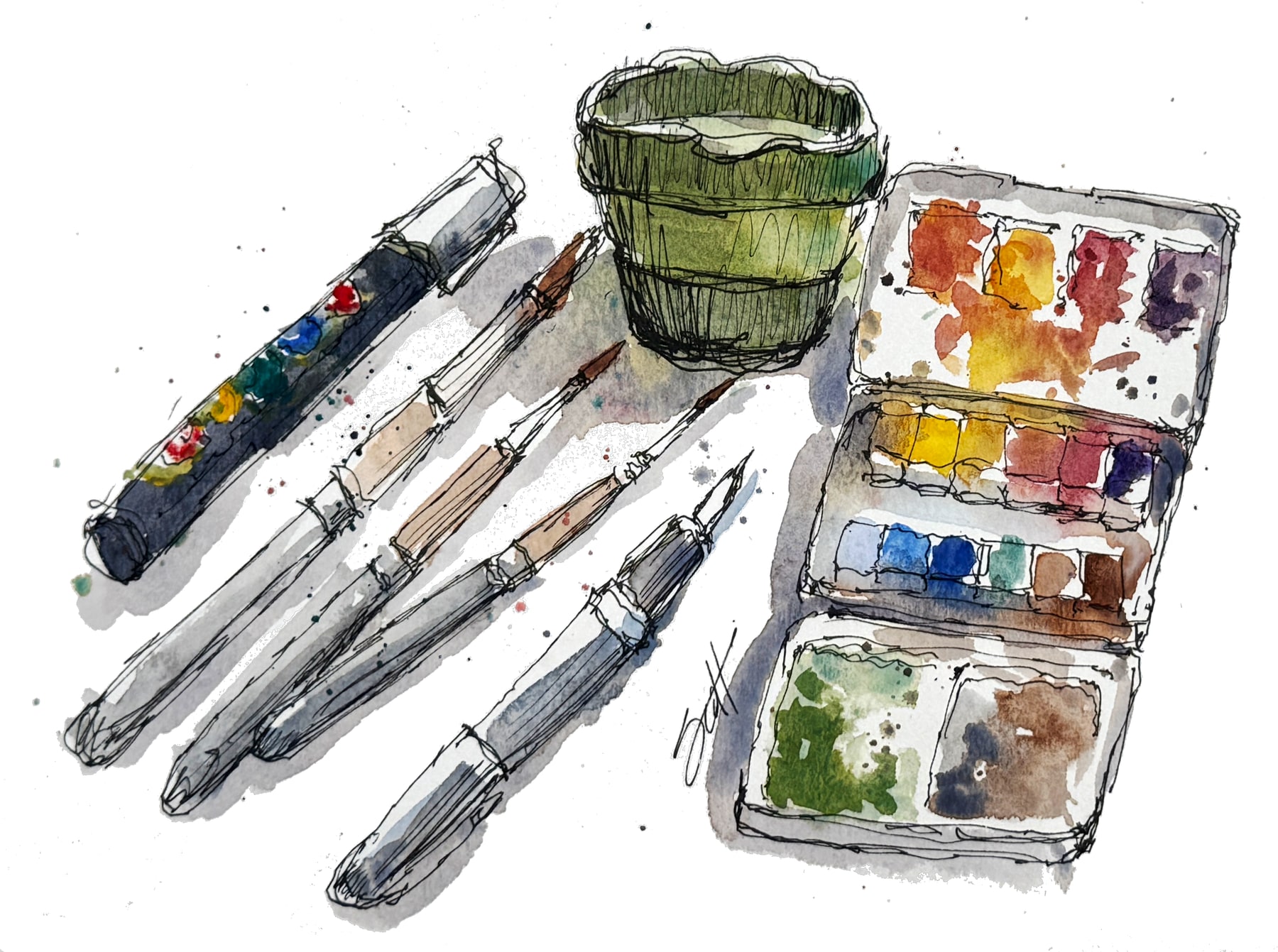
My original goal was a modest, self-published collection of perhaps 60 pages. The work progressed in fits and starts until retirement gave me the time to return to it with renewed focus. Today, the collection has grown to more than 120 pages and has become something far more substantial than I first imagined.
Conversations with local historians and preservationists helped shape what came next. Their knowledge and passion made one thing clear: if I waited until everyone’s favorite place was included, the book might never be finished. An historic neighborhood is not a completed story. There is always another place to discover, another memory to record, and another piece of history to add or amend.
That realization inspired this companion website, a free community resource that can supplement the book or stand entirely on its own. It is meant to grow through new property suggestions, shared knowledge, and updated histories, becoming more useful over time to residents and visitors, artists and architecture lovers, preservationists and history buffs. It might even spawn a Volume 2.
Yes, the website may help sell a few books, but book sales were never the reason for the project. The reason is the art: the joy of slowing down, looking closely, painting what I see, and sharing these remarkable places with others.